"Behind The Curtain" (Part 2) - 5 Things Small Businesses MUST KNOW

In part 1 of "Behind The Curtain" we exposed the 2 biggest Internet marketing falsehoods that small business owners are told. Part 2 takes it a step further. If there were only 5 critical pieces of advice we could give to a small business owner regarding the marketing & advertising of their business today they would be:

  1. Isolate your advertising programs and evaluate each one individually - Many small businesses do multiple advertising programs at once (yellow pages, direct mail, online advertising, etc.) with a single large media corporation, and do not know which programs are performing well and which programs are not. Representatives from these media corporations will often present "bundles" where multiple programs are packaged as one. The problem with this approach is the business owner does not see the cost and performance of each program individually. Ask your representative to review with you the cost & performance of each program individually so you can decrease or eliminate the programs that are not performing up to par, and devote more of your budget to the programs that are working well. Another recommendation is to seek the expertise of an independent consultant, who is not biased towards any particular advertising medium. They will give you an honest evaluation of each individual campaign and recommendations on how to better invest your budget.
  2. Refuse to pay as much for print advertising as you did in the past - If the audience has declined (which it has) then so should your investment. People still use the phone book and read the newspaper but not nearly as many as before. There's still some value for your business in having visibility in these mediums so don't decrease your presence, just decrease your investment. Your yellow pages or newspaper rep will not like this, and will say you can't do it, but you can. If you need help executing this strategy contact us.
  3. Refuse to do long contracts with Internet marketing programs - If a company tries to make you sign a 6 or 12 month contract for Internet marketing services just say no. Most reputable Internet marketing firms offer short term, or month to month programs because they know if you're happy with their services then you will continue on with them, without needing to be "locked" into a contract.
  4. Own and have full control of your website domain name - There's been far too many nightmare situations where a business buys a website from a company without realizing they don't own the domain name. When they decide to sever ties with that company they lose the website and have to start over from scratch with a new domain. Make sure you are the owner of your domain name and have it registered under your own registrar.
  5. Don't advertise on Yelp - We have nothing personal against Yelp and actually stress the importance of a business having a free listing with them but stick with just the free listing. The truth is Yelp has a very aggressive sales force and the most inflated pricing on the Internet. Until this changes don't sink your advertising funds into Yelp because the return on investment can't be justified. There's far better places on the Internet to invest your budget.
The goal of "Behind The Curtain" is to help make the Internet marketing industry more open and honest, and to help educate small business owners with the knowledge needed to make intelligent decisions, based on the truth.

"Behind The Curtain" (Part 1) - The 2 Biggest Internet Marketing Lies That Small Businesses Are Told

Unfortunately the Internet marketing industry contains some salespeople who either don't have the experience and knowledge to properly advise small business owners, or deliberately mislead business owners into doing business with their company by giving them false information.

In part 1 of "Behind The Curtain", we expose the 2 most widely told falsehoods in the Internet marketing industry and how business owners can protect themselves from being misled.

Here are the 2 most common Internet marketing lies that small business owners are told:

1. We run your search engine advertising for free! 100% of your monthly budget goes to the search engines and we get paid by Google! The truth is when you run your Google advertising through a large media corporation there are a lot of hands in the pot. In most cases you are paying a 50% margin or more to the media corporation. For example, if you invest a $1000/month budget into a Google advertising program through a media company, $500 of that is going directly to the media company and only $500 is going to the Google Advertising. No one is saying that the media corporation doesn't deserve to be paid to provide this service, but 50% is absurd. A fair percentage is 10-20% and most smaller firms are in that range. If you have the time and knowledge to run your own, you could do the self-serve option with Google, but we typically recommend working with a smaller firm that is transparent and honest about the cost of providing the service. Google advertising can be extremely beneficial to a business if done properly and with the right strategy, but proceed with caution! If a company won't disclose what the cost of their service is, or says there is no cost, steer clear!

2. We have a "special relationship" with Google that allows us to get your business better placement, results, lower cost per click, etc. The truth is no company has any advantage because of how big they are or how many clients they advertise on Google. Large corporations have been claiming for years that they are "tied in" with Google or can deliver better results because of their size or "secret partnership". This is, and has always been, a flat out lie. If a sales rep tries this approach with you steer clear! It's a major red flag that they either lack serious knowledge on the subject or are straight out lying to you. Either way that's not someone you want to do business with.

The goal of "Behind The Curtain" is to help make the Internet marketing industry more open and honest, and to help educate small business owners with the knowledge needed to make intelligent decisions, based on the truth. In part 2 we will disclose the 5 most critical things for a small business owner to know right now about marketing/advertising.

Important New Data About Working From Home

Telecommuting (working form home) is a hot topic right now. Marissa Mayer (new CEO of Yahoo) recently told employees they couldn't work from home because it hurts "speed and quality." The debate will fuel on with opinions from both sides, but we predict that telecommuting will continue to increase at a rapid rate moving forward. Here are 5 interesting things to consider based on new data:
  1. Telecommuters are almost twice as likely to work more than 40 hours a week.
  2. The average annual savings for a business if an employee with a telecommute-compatible job works from home half the time is $11,000.
  3. The average telecommuter saves $2,000 to $7,000 annually on transportation and other expenses.
  4. The percentage of telecommuters increased 60% from 2005 to 2011.
  5. Telecommuters are 6% to 10% less productive than on-site employees when doing repetitive work but are 11% to 20% more productive when performing creative tasks.


A New Free Tool From Google To Help Keep You Organized

We all seem to be living busier, more fast-paced lives than before due to an abundance of information flying at us from all directions. There's more to do and more to remember these days, and being efficient is crucial to success in business and life overall. Google has unveiled an application called Google Keep to help the average person stay organized (ideal for the busy small business owner). Below is a quote and short video from Google:

"Every day we all see, hear or think of things we need to remember. Usually we grab a pad of sticky-notes, scribble a reminder and put it on the desk, the fridge or the relevant page of a magazine. Unfortunately, if you’re like me you probably often discover that the desk, fridge or magazine wasn’t such a clever place to leave the note after all...it’s rarely where you need it when you need it.

To solve this problem we’ve created Google Keep. With Keep you can quickly jot ideas down when you think of them and even include checklists and photos to keep track of what’s important to you. Your notes are safely stored in Google Drive and synced to all your devices so you can always have them at hand.

If it’s more convenient to speak than to type that’s fine—Keep transcribes voice memos for you automatically. There’s super-fast search to find what you’re looking for and when you’re finished with a note you can archive or delete it."


Google Keep is available on Google Play for devices running Android 4.0, Ice Cream Sandwich and above. You can access, edit and create new notes on the web at http://drive.google.com/keep and in the coming weeks you'll be able to do the same directly from Google Drive.

What You Need to Know About Your Website Traffic

We believe that every business website should have some form of analytics or tracking installed so that traffic can be measured and analyzed. Along with that though comes the need to understand the information that is captured. An analytics report will give back an awful lot of data & metrics but what does the business owner really need to know in order to evaluate the performance? Keep reading and we will tell you exactly what's most important to know:

One of the single most important (and often overlooked) aspects of a website traffic report is the % of new visitors vs. returning visitors. Google defines a "new visitor" as someone who visited your website for the first time. Your current customers most likely search for your business by name. But prospective customers tend to search by topic, such as "dentist" or "florists" or "oil change".
Google Analytics For Small Business

If a major goal of your Internet marketing program is to generate potential new customers (as it is in most cases) then the new visitor % stat is a really important one since it's a great indicator of who is visiting your website. Is your website traffic mostly existing customers and returning visitors, who probably typed your business name into a search engine? Or do you have a higher percentage of new visitors (potential new customers) who found your website by typing in a new business search (like "insurance agent", "transmission repair shop", "roofing company in Boston", etc.)?

The ideal new visitor % in your website traffic report will differ based on your business category but if you are finding a small percentage of your website traffic coming from new visitors then you probably have a case of poor search engine rankings for new business searches in your local market. For example, if you are a dentist in Providence, RI and your website does not show on the first page of Google for the keyword search "Dentist Providence, RI" then you most likely are not getting a large percentage of new visitors to your website. Instead, your website traffic is mostly comprised of existing patients who need to find your phone number or address. Existing customers finding you is certainly a good thing but if business growth from the Internet is a goal then you also need a healthy percentage of new traffic consistently visiting your website.

Have questions about whether your website traffic is helping you achieve your business goals? Contact us!

What Einstein Would Say to Internet Marketing Companies

SEO Company New Hampshire
I think those in the Internet marketing industry would all agree that it's a very complex field they work in.  One part of the job is to be a subject-matter expert - to be a master of search engine optimization, social media marketing, and website design, among other things.  It's an industry that's constantly changing.  Google updates their website ranking algorithm hundreds of times a year now and new social media sites are popping up left and right.  It's our job to stay ahead of the curve for our clients and deliver results in this ever-changing landscape.  It's a complicated and tough job but we know what we signed up for and are very grateful for the opportunity to help businesses online.

However, there's a second piece of the job that many are failing at in this industry, which goes back to Einstein's quote.  Far too often, Internet marketing firms are confusing small business owners by failing to simplify the message.  Granted, it's no easy task to take all this highly-complicated information and put it into a simplified form that the business owner will understand, but it's crucial. If the business owner is confused about what services they are getting, and what the results of the program are, then the Internet marketing firm is not doing the full job.

In far too many cases online marketing companies are either not relaying this information at all, or relaying the information to the business owner in "industry terms", with technical jargon that means nothing to them.  I often compare it to a doctor speaking a bunch of medical terms to the patient when giving the diagnosis and treatment plan.

So remember, a good Internet marketing firm should not only have expertise in Internet marketing, but also in communicating a simplified message to the client.

A Brand New Reason Why Your Small Business Needs Facebook

One of the most common questions we get asked by small business owners is "Why is it important for my business to have a Facebook page?"  Up to this point our answer included:

1.  It helps the visibility of your business on search engines like Google.
2.  It's a great way to engage your existing customer base.

Now we can add another huge new reason: Facebook is on its way to becoming a search engine for local businesses.

Yesterday, Facebook updated the Nearby feature in its iPhone and Android apps to enable users to find nearby local businesses by name or by category. Results will be ranked by ratings, recommendations, check-ins and "Likes".

Facebook is entering the local search arena.
Only those businesses that have a Facebook Page will be listed, creating a powerful new incentive to create a Facebook Page.

It’s only mobile (for now). And there are no ads planned for the immediate future, but you can imagine that will change in all probability over time and we believe that the goal is to compete with search engines like Google and review sites like Yelp.

Below is an official statement from Facebook as well as a few tips for local businesses:

Local businesses have always relied on word-of-mouth recommendations to gain new customers and grow their sales. Whether they’re a new restaurant in the neighborhood, a favorite salon, or a trusted tailor, small businesses often depend on social endorsements to get discovered.

And recommendations from friends become even more important when people are on the go. In fact, 150 million people visit Pages on Facebook every day globally. And in the US, over half of visitors to Facebook Pages are visiting them from a mobile device. 
Today we're pleased to announce updates to Nearby, accessed via the Facebook mobile app: now, in addition to showing which friends have checked in at a particular place, Nearby helps people discover places near them based on their friends’ recommendations. People can explore by category (ex: restaurants or hotels); connect to businesses directly from their phone (by liking, checking in, calling, or getting directions); rate the places they visit via a five-star system; and share their recommendations with friends.

If you have a Page on Facebook with a location, your business now has another way to be discovered by Facebook's 600 million-plus mobile consumers.

When someone looks for a place, the results that appear in their Nearby list are based on things like their friends' recommendations, ratings, check-ins, and likes. If you're a business with a physical location, here's what you can do to ensure your place is more easily discoverable in Nearby:
  • Update your Page to include all of your basic information, including your address, store hours, phone number, and details about your business in the About section
  • Update your category to make sure you appear when people are looking for your specific type of business
  • Encourage your consumers to like, check into, rate, and recommend your place

Based on this news, there has never been a better time for a small business to contact Network For Solutions.  We will make sure your business is ahead of the curve and utilizing the Internet the right way!

Small Business Did You Know?

  • 97% of Americans who use the Internet are looking online for local products and services.
  • Yet, more than half of all small businesses in the U.S. don’t have a website.
  • Since small businesses make up half of the U.S. GDP and contribute two-thirds of all new jobs, the potential impact of getting these businesses (more than 15 million of them) online is enormous.

Call (866) 234-7170 to plug your business into the network today!


How To Reach Your Target Audience

On Small Business Saturday®, an estimated 103 million people shopped small on November 26th of last year. But did you know that you have access to tools and resources that can help encourage your customers to shop small and help grow your business all year-round?

It starts with our toolkit at www.facebook.com/shopsmall, which we've updated and expanded so you can reach your ideal clients. You'll find tools like My Business Story, which shows you how to create a video that allows potential customers to see what makes your business special and learn about the kinds of services you offer. Find more ways to promote your business with Facebook in this month's Expert Analysis by blogger and social media strategist Angela Stringfellow.

We've also teamed up with Facebook to give you the opportunity to boost your social media presence with the Big Break contest. In our Featured Video, learn how to enter for an opportunity to win $25,000 to grow your business and drive customers to your door – and a one-on-one strategy session with American Express and Facebook to put it all into action. Enter through July 9, 2012 at www.facebook.com/OPEN.

The Benefits of a Blog for a Small Business

Many articles have been written over the years enumerating the benefits of blogging for online lead generation. While blogging is but one of many ways to generate leads online, there is significant data to back these assertions up. Here are just a few data points in support of business blogging:
  • B2B companies that blog get 67% more leads/month
  • B2C companies that blog get 88% more leads/month
  • Companies that blog have 55% more website visitors
For the sake of simplicity, there are three broad reasons why blogging helps companies generate leads online:
1.      It drives traffic your brand
2.      It amplifies your brand message
3.      It helps legitimize your brand
DRIVE TRAFFIC
Blogging helps drive traffic to your website by creating indexed pages and (eventually) inbound links to your site, both of which are critical to SERP (search engine page rankings).
Exemplified by Google’s Panda update, search engines are increasingly favoring fresh, high-quality content in search rankings. The nice thing about blogging is that each blog has a discrete URL, and as such is a separate web page that can be indexed by search engines. The more blog posts you publish, the more indexed pages you create for search engines to display in their results, which in turn helps your page ranking on Internet searches. Also, search engine web-crawlers tend to favor original content that has a more recent timestamp; they may skip over content deemed replicated or already indexed.
Inbound links (aka “backlinks”) are simply links that come from an external site to your website. When you blog, you are creating fresh, thoughtful (hopefully) content that others may find relevant or interesting. If an external site references your blog, they will usually include a backlink to your original blog page. The number of backlinks is an indication of the popularity or authority of a website.
Backlinks are important for SEO because some search engines like Google give more credit to websites that have a large number of quality backlinks, and consider those websites more relevant than others in their results pages for a search query.
By creating indexed pages and attracting inbound links, blogging will help your company generate organic traffic, the first step in online lead generation.
AMPLIFY YOUR MESSAGE
With the massive growth of social, integrating your web-based blog posts with social media can exponentially amplify your message.
As a matter of form, blogging is considered to be part of social media.  Hair-splitting aside, most business blogs are website-based, therefore it is critical that brands actively integrate blog posts with their social media channels like Facebook, Twitter, LinkedIn, and especially Google+. Each time a blog is published, it should be automatically shared throughout your various social media. Moreover, you should dedicate resources to actively promote your blog posts on each social media channel.
LEGITIMIZE YOUR BRAND
As Randa Clay aptly pointed out in a recent Fast Company blog, the more customers know you, the more loyal they become. Blogging builds consumer loyalty and trust by helping prospects and customers solve problems or address pain-points.  Most blogs will offer a subscription option through RSS and email, giving your company an opportunity to interact with subscribers every time a post is published.
Brands often use business blogging as a platform to show off their industry expertise and establish thought leadership. A recent survey conducted by Fast Company found that 71% of respondents said blogs affect their purchasing decisions either somewhat or very much.
In an increasingly crowded Internet, blogging provides your company an actionable way to drive web traffic, amplify your message, and legitimize your brand. In turn, all of these efforts will help your business generate leads online.

How Users Search For Local Businesses

One of the most common questions we get asked by clients is "how many people are searching for my business on Google and how are they searching for it?"

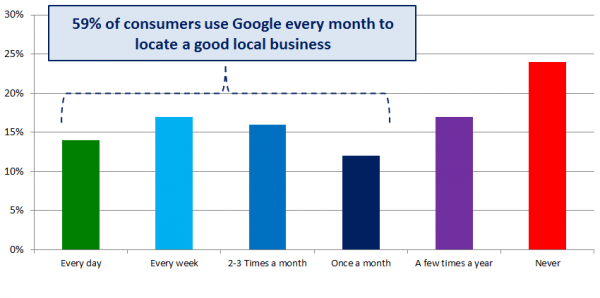
Third Door Media recently conducted a survey with a panel of 1250 local consumers based in the U.S. (broad mix of ages, gender and location).  The first interesting result was that 59% use Google at least once a month to search for a local business:


The second interesting result was that 54% use a local modifier in their search terms (ex. Dentist Boston or Dentist 02101) rather than just "Dentist".


The survey also shows that 17% of searchers never use a local modifier in their search terms, with this percentage rising to 21% among younger searchers. However, older searchers are more inclined to add a local modifier to their search terms — 63% usually do.

To take it a step further, when a geo-modifier is used, here is the breakdown of what type:


In conclusion, it's very important for a business (and its marketing firm) to understand not only who and how often people are searching for it online, but also specifically how it's being searched as well.  This data is very useful in customizing an online marketing campaign to the target audience of the business.

Call us at (978) 494-4119 to schedule an online marketing consultation for your business today!

Small Business Saturday


We support Small Business Saturday on behalf of our firm and our clients
The 2nd annual Small Business Saturday is
a day dedicated to supporting small businesses
on one of the busiest shopping weekends of the year.
On November 26, we’re asking millions of Americans to shop small at their favorite local stores and help fuel the economy. When we all shop small, it will be huge.

Help spread the word - "Like" Small Business Saturday on Facebook and join this growing movement!

Are You Using Technology To Your Advantage?

During our marketing workshops, one of the most important topics we discuss with business owners is how to harness the amazing growth of technology to help their productivity.  Many business owners feel as if they are busier and working harder than ever, yet their overall productivity is lower than ever.  They are investing more time and energy into their businesses but they are not seeing growth.  The main reason is that they have not yet seized the tremendous opportunity that new technology has created for them; rather they have allowed technology to work against them.

The bestselling author, Neil Strauss, made a very insightful and accurate reference to this issue recently:

It's easy to be BUSY these days, but more and more people are having
trouble being PRODUCTIVE.

We are in the Information Age. We have an incredible body of
unlimited knowledge and access to over a billion people available
instantly--and we can carry all this information and connectivity on
a device we can literally fit in our pocket.

It's incredible--an amazing period of history to all be living
through together--but it's also a challenge.

And the challenge is this: Are you living your life or are you
being distracted from it?

We completely agree with Neil about this challenge that all of us face.  There is so much information constantly being thrown at us now, that we often mistake the feeling of being busy and productive for actual production.

Business owners need to transform their businesses to align them effectively with the Information Age, and in order to do that they need to utilize technology to their advantage.  The exponential growth of the Internet and technology presents an incredible opportunity to gain a competitive advantage in the marketplace...with the right guidance and strategy in place.

Call us at (978) 494-4119 to discuss how we can help you with this challenge and take your business to the next level.  It's time to let technology work FOR you and your business!

http://www.networkforsolutions.com/

10 Reasons to GO LOCAL

Why Support Locally Owned Businesses?

1.  Local Character and Prosperity - In an increasingly homogenized world, communities that preserve their one-of-a-kind businesses and distinctive character have an economic advantage.
2.  Community Well-Being - Locally owned businesses build strong communities by sustaining vibrant town centers, linking neighbors in a web of economic and social relationships, and contributing to local causes.
3. Local Decision-Making - Local ownership ensures that important decisions are made locally by people who live in the community and who will feel the impacts of those decisions.
4.  Keeping Dollars in the Local Economy - Compared to chain stores, locally owned businesses recycle a much larger share of their revenue back into the local economy, enriching the whole community.
5.  Job and Wages - Locally owned businesses create more jobs locally and, in some sectors, provide better wages and benefits than chains do.
6.  Entrepreneurship - Entrepreneurship fuels America's economic innovation and prosperity, and serves as a key means for families to move out of low-wage jobs and into the middle class.
7.  Public Benefits and Costs - Local stores in town centers require comparatively little infrastructure and make more efficient use of public services relative to big box stores and strip shopping malls.
8.  Environmental Sustainability - Local stores help to sustain vibrant, compact, walkable town centers-which in turn are essential to reducing sprawl, automobile use, habitat loss, and air and water pollution.
9.  Competition - A marketplace of tens of thousands of small businesses is the best way to ensure innovation and low prices over the long-term.
10.  Product Diversity - A multitude of small businesses, each selecting products based, not on a national sales plan, but on their own interests and the needs of their local customers, guarantees a much broader range of product choices.

Time & Money

"Money is not the primary asset in life...Time is"

-Gordon Gekko

Mr. Gekko, the anti-hero from the Wall Street movies, is certainly not the most honorable character, to say the least, but he was right on the money (no pun intended) with that quote. This view on time is not that of the 1980's Gekko from the first movie; it's the view of a man who has just spent 8 years in prison and has come to the harsh realization that the most precious thing of all is time.

At Network For Solutions, we believe in this principle whole-heartedly, from a personal and business standpoint. The reason our firm exists is because our clients realize that they have a limited amount of time each day to run their business. To take precious hours out of the day and attempt to market their business, in a complicated landscape, is not the best use of time. They could have used that time to do what they do best; run their business. Instead they partner with us for our expertise and resources to grow their business.

Most people, at certain points along the way, will take a step back to assess their personal life and how they're spending their most precious resource. Am I spending my time wisely and focused on the right things? Am I making the most of my time here?

We believe that business owners should take the same approach. Am I maximizing my time running my business? Is it a smart decision to spend valuable hours of my day trying to market my business? Or would it be wiser to invest money to partner with a marketing firm and devote that time saved to running my business?

These are the assessments we engage in with our clients. As consultants we want to gain an understanding of the business, the vision and goals; and use our expertise to help them get there.

In a recent survey published by Inc. Magazine on Work-Life Balance, over 30% of small-business owners admitted they would rather have more time than more money. At Network For Solutions, we clearly understand how money is a valuable asset for a person and a business, but, as Mr. Gekko realized, it's not the most important asset. Perhaps the author, Harvey Mackay, put it best:


“Time is free, but it's priceless. You can't

own it, but you can use it. You can't keep

it, but you can spend it. Once you've lost it

you can never get it back.”


http://www.networkforsolutions.com

IBM: Lessons from the Great Depression

IBM is currently the 48th largest corporation in the world, but even the smallest local businesses can learn a valuable lesson from how this great company positioned itself for future success during terrible economic conditions.

This article was written by Kevin Maney on 10/10/08 during the heart of our current recession:

IBM has a habit of being a beacon during economic calamity. Of course, its earnings yesterday helped everyone feel for at least a moment that the world wasn't coming to an end. But that pales in comparison to IBM's feat during the Great Depression. Hopefully, we'll see more of the same from the company.  I know about this because I wrote a book about the guy who built IBM, Thomas Watson Sr., titled The Maverick and His Machine.

IBM may seem pretty staid today, but Watson was actually quite the gambler. As the Depression killed off IBM customers and forced others to cut back on orders, Watson pledged that he would not shut a single factory or lay off a single worker. In fact, he recognized that while his competitors were down, he could make investments that would better position IBM when the economy turned around. 

In 1932, he announced that IBM would spend $1 million -- an enormous sum for the company then -- to build a stand-alone R&D lab in Endicott, N.Y. every competitor at the time was slicing R&D. Watson added employees and expanded factory capacity. If no one was ordering IBM punch-card machines, Watson told the factories to keep making machines and spare parts and store them in warehouses. 

As sales stalled, this put enormous financial pressure on IBM. Investors started pitching a fit. In 1932, IBM shares fell to 1921 levels. The board of directors started discussing firing Watson, but he held them off. As the late, great Peter Drucker told me about Watson, "He didn't know how close he'd come to collapse."

In 1935, Watson's stubbornness paid off. That year, FDR signed the Social Security Act, instantly creating enormous demand for data processing machines. The government needed them to process claims and companies needed them to gather and send information to the government. IBM had been stockpiling machines and investing in new technologies, while competitors had shut factories and stopped R&D. IBM cleaned up -- and in fact that moment was the slingshot that allowed IBM to utterly dominate the IT industry for the next 50 years.

In the process, Watson got rich during the worst economic despair in U.S. history. In the late-1930s, he was one of the highest-paid Americans, making more than $350,000 a year -- more than $5.2 million in today's dollars. 
If today's executives remember that lesson, we'll get out of this economic jam a whole lot sooner.

1/23/11 - Even the smallest of local businesses can learn from this story.  Are you in "retreat" mode? Or are you positioning yourself for future success.  The businesses that are taking advantage of the opportunities that an economic recession provide will be the ones who dominate the competition in the future.  Contact http://www.networkforsolutions.com/ to discuss.